


Unearthed Honor: Major Allen G. Oden
NBHS Historian/Claudia Houston
Greenwood Cemetery on Cypress Street is a historic Black burial ground whose years are shown by sunken stones, letters worn by weather and memorials broken. A few years ago, volunteers with brushes and trowels cleaned headstones to better reveal the identities of the soldiers buried there. The Civil War Trails marker at the entrance lists five U.S. Colored Troops (USCT) veterans, but the ground revealed otherwise. Researchers confirmed nine; then a tenth appeared much later. This headstone was flat, hidden beneath soil and vines. When it was cleaned, the name Major Allen G. Oden was revealed.
What is the story behind the stone? Allen Oden was born enslaved in Beaufort County, North Carolina, on July 8, 1840, one of more than ninety people enslaved by members of the Oden family. At age eight, his parents were sold leaving him with no family.
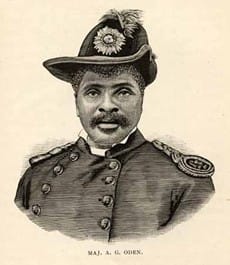
The Civil War opened a path for many enslaved and Allen Oden, at the age of twenty-four, enlisted in the United States Colored Troops in Washington, NC. He was promoted to First Sergeant in January 1864 and served in Company H, 36th USCT Regiment. He mustered out with his men at the Brazos in Texas on June 16, 1866. Famed Church leader, James Walker Hood, later wrote that Oden had been “awarded a medal by General Grant for bravery in the Battle of New Market, Va., which was lost or misplaced by the commanding officer of his company, and it never reached his hands.” His military and pension files do not record such a medal, but they do trace service through Fort Wagner, Deep Bottom, and New Market Heights, among other campaigns that changed the country.
After the war, Oden was determined to build. He taught school and to earn extra money, he worked in the shingle swamps, where the work was physically demanding. He soon made a bargain with Charles Jones, a local shoemaker. Oden would teach Jones vocal music if Jones would teach him the shoemaker’s trade. In 1872 Major Oden joined the AME Zion Church and attended the denomination’s national conference in New Bern in 1888 and served as a delegate in Pittsburgh in 1892.
Oden proved trustworthy and voters elected him as coroner three times, and he represented the Fifth Ward on New Bern’s Board of Aldermen. In fraternal life he rose to be Master of King Solomon’s Lodge No. 1, a Black Masonic lodge that still exists in New Bern. In 1877 he joined one of two all-Black battalions of the North Carolina State Guard and was appointed Major of the Fourth Battalion, which was composed of men from New Bern and Raleigh. The title “Major” stayed with him and carried into civic life.
With fellow Black veterans, Oden helped found a local Grand Army of the Republic post named for Colonel James Beecher who led an African Brigade in 1863. By 1890, the post had thirty-three members and Oden served as commander for five years. He also presided over the Christian Aid Society while remaining an active Master Mason at King Solomon Lodge.
Home was on South Street, where Oden worked as a shoemaker and his wife, Dicey, was employed at an eating house. Their South Street property was assessed at $400, and he owned a second lot on Craven Street, valued at $150, which was his workshop. Oden died on September 29, 1894, and was buried the next day from Clinton Chapel A.M.E. Zion Church. Dicey was able to remain in home they shared assisted by a Civil War pension.
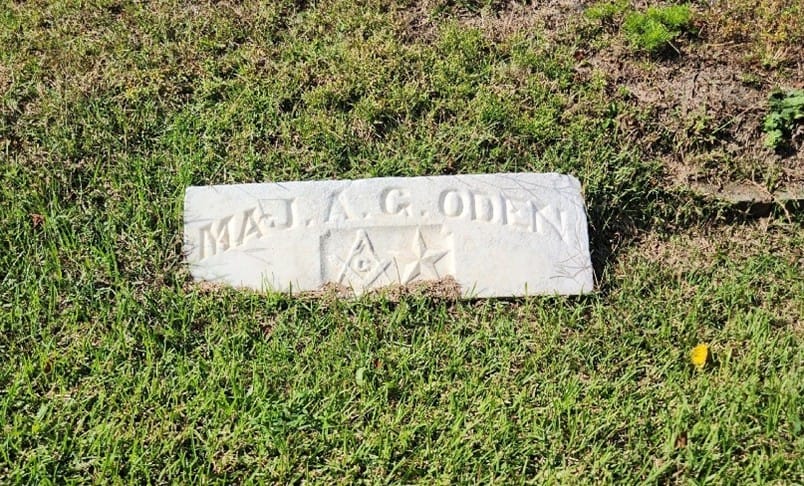 Major Oden’s headstone in Greenwood was once lost, but it has been cleaned and can now be found. Major Oden has also been memorialized on the African American Civil War Memorial in Washington DC, plaque C-51. Records suggest Dicey is buried nearby in Greenwood but there appears to be no headstone. Perhaps one day we will find it.